Co-authored by proveo and Alps Alpine
Non-motorized GSE tracking: Same airport. Same fleet. Same shift. Three completely different realities happening at once.
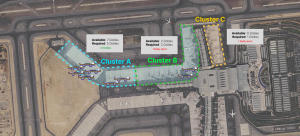
Cluster A has 7 dollies available against 5 required. A healthy surplus. Cluster B has 2 against 3 and already short by one. Cluster C has zero against 1 required. A hard stop.
This is not a fleet size problem. It is a visibility problem. For ground handlers managing hundreds or thousands of dollies, carts, towbars and other assets, non-motorized GSE tracking provides the missing visibility into where equipment actually is and whether it is available when operations need it. And it plays out on ramps at airports around the world, every single shift.
The Real Cost of Poor GSE Visibility at Airports
When a cluster runs short, someone has to fix it fast. That usually means a supervisor walking the ramp to find equipment that should already be nearby. Or a handler driving across the apron to pull dollies from a cluster that has a surplus, assuming they know which one that is. Or, in the worst case, nobody realises until the turnaround is already underway and there is nothing to load onto.
A shortage at Cluster C does not stay at Cluster C. It delays the flight. It creates pressure on the handling team. It forces reactive decisions at exactly the moment when everyone is already operating under the tightest possible time window.
Why Non-Motorized GSE Is the Hardest to Track
Motorized GSE gets attention. Tugs, tractors, and vehicles have engines, fuel logs, telematics systems, and maintenance records. Someone is usually keeping an eye on them. Non-motorized equipment is different. Dollies, carts, and towbars move constantly between clusters, gates, and shifts. Once it moves, keeping track of it depends entirely on someone remembering to update a record. On a working ramp, that is a lot to count on. Traditional methods do not hold up at the pace ground operations actually run. Manual logs go stale within minutes on a busy ramp.
So supervisors end up doing what supervisors have always done. They Drive Around. They walk. They ask around. They find the dolly, move it, and get back to the next problem. It works until it doesn’t, and when it doesn’t, the clock is already running.
How Non-Motorized GSE Tracking Creates Cluster-Level Visibility
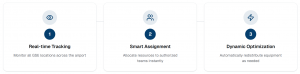
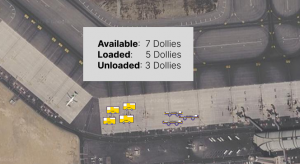
proveo and Alps Alpine Asset Tracking built a different approach to this problem. Alps Alpine’s asset trackers are attached to non-motorized GSE, such as dollies, carts, towbars, and integrated directly into the proveo platform. The result is near-real-time location data for every tracked asset, mapped against the clusters where demand is building.
This also changes how reallocation decisions get made. Instead of moving equipment reactively, after a shortage has already shown up, a supervisor can see the imbalance building and act on it before Cluster B goes short and Cluster C hits zero. The surplus in Cluster A becomes useful information rather than something that only gets noticed after the fact.
The loaded and unloaded status of each dolly adds another layer. A dolly sitting loaded in the wrong cluster is not available in the way an empty one is. Knowing the difference before sending someone to collect it saves time that a busy shift does not have.
How Non-Motorized GSE Tracking Creates Cluster-Level Visibility
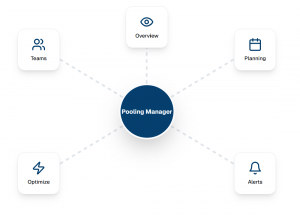
One of the most practical aspects of this setup is that it does not require a separate system for non-motorized GSE. The Alps Alpine Asset Tracking trackers feed directly into the proveo platform alongside motorized GSE data. A fleet manager or supervisor gets one view of the full ramp without switching between systems or reconciling two separate data sets.
This matters in practice because cluster imbalances rarely involve just dollies. A shortage of non-motorized equipment often coincides with motorized GSE being tied up somewhere else. Seeing both in the same place makes it faster to understand what is actually happening and what needs to move.
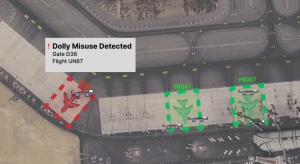
The misuse detection capability shows what is possible when you have this kind of visibility. When a dolly moves to a gate or cluster, it should not be in there, whether through honest mistake or informal reallocation; the platform flags it with the gate and flight number. A supervisor knows immediately, rather than discovering it when the next team goes to collect equipment that is no longer where it was left.
From Reactive Dolly Searches to Proactive GSE Management
The cluster scenario at the top of this post is not unusual. It is the default state of most airport ramps during a peak window. Equipment drifts. Clusters go out of balance. Someone finds out too late.
Getting ahead of it does not require a new fleet. It requires knowing where the fleet actually is.
With cluster-level visibility in place, the question stops being “where is it?” and becomes “where does it need to go next?” That shift from reactive to proactive is what changes the shape of a peak window. Reallocation happens before the shortage, not after. Supervisors manage the ramp instead of searching it. Flights leave on time.
For ground handling teams already running hard schedules with tight turnarounds, that is not a small operational improvement. It is the difference between a shift that runs and one that catches up all day.
Improve Visibility of Your Non-Motorized GSE
If your operation is managing dollies across multiple clusters and the balance across them is something your team finds out about after it becomes a problem, we are happy to talk through what near-real-time visibility could look like for your specific setup.
Reach out to the proveo team or get in touch with Alps Alpine Asset Tracking. We will start with the problem, not the product, and go from there.
Frequently Asked Questions About Non-Motorized GSE Tracking
What is non-motorized GSE tracking?
Non-motorized GSE tracking uses battery-powered tracking devices to provide location and status information for airport ground support equipment without its own power source, including dollies, carts, towbars and other mobile assets.
How can airports track baggage dollies?
Ground handlers can install tracking devices on baggage dollies to provide near-real-time location information. The tracking data can then be integrated into a GSE management platform to show the location and availability of equipment across airport operational areas.
Can motorized and non-motorized GSE be tracked in one system?
Yes. The proveo platform combines telematics data from motorized GSE with tracking data from non-motorized assets, giving ground handlers a unified view of their equipment.
What are the benefits of tracking non-motorized GSE?
Tracking helps ground handlers identify equipment shortages, locate misplaced assets, improve fleet utilization, reduce unnecessary ramp movements and make equipment reallocation decisions before shortages affect operations.