Navigating the complex world of fleet and asset management with flexibility and expertise

For over two decades, proveo has led the way in Fleet Management & Telematics for Ground Handling, thriving in the highly complex aviation sector. As a German company, we started our journey in one of the most challenging industries.  

Managing a fleet in the aviation industry is no easy task – from maintaining safety standards to optimizing turnaround times, ground handling teams face a mountain of challenges.  

Unlike traditional fleet management systems, proveo offers unique solutions tailored specifically for the aviation market. From seamless compliance with IATA IGOM standards to custom solutions tailored for ground handlers and airlines, our system can adapt to all kinds of use cases across industries. 


Traditional and proveos solution compare


Challenges in Fleet Management & Telematics for Ground Handling – and How We Solve Them 

Choosing the right telematics system is crucial; it must be able to grow alongside your operational complexity and adapt to future requirements. Managing fleet operations means coordinating between multiple stakeholders, departments, different processes, vehicle types, and diverse needs—making the right choice in telematics solutions essential. The following challenges highlight why aviation-specific fleet management solutions are needed. 

 challanges in aviation fleet management

1. Safety Compliance with IATA IGOM Standards

Safety is non-negotiable in aviation. Ground handlers must comply with rigorous safety standards to ensure consistent service across the globe. Our fleet management system helps to comply with the IATA Ground Operations Manual (IGOM), reducing risks of injuries and aircraft damage. By integrating IGOM standards into daily operations, our solution will be able to support procedures that enhance safety for all stakeholders. 

2. Turnaround Optimization for Better Performance

Delays can be costly for airlines, both financially and in passenger satisfaction. Our system helps track and analyze each stage of the turnaround involving Ground support equipment (GSE), allowing for better coordination and reduced delays, ultimately improving on-time departures.   

3. Advanced Solutions for Fleet Management & Telematics for Ground Handling

Avoiding vehicle downtime is crucial for uninterrupted airport operations. proveo’s telematics solution provides real-time insights into vehicle conditions and maintenance schedules. This proactive approach addresses potential issues before they become critical, minimizing disruptions and lowering maintenance costs. 

4. Reducing Airport Congestion

Busy airports often struggle with traffic flow and congestion, leading to potential delays and reduced efficiency. Optimizing asset distribution and routing is essential for reducing congestion, maintaining efficient ground operations, and ensuring on-time performance. By using data-driven asset allocation, our clients have reported smoother operations and reduced turnaround times, helping to keep passengers happy and flights on schedule. 

5. Optimizing Airline Customer Experience

Efficient ground operations have a direct impact on passenger satisfaction. Synchronizing luggage handling, catering, and refueling with flight schedules leads to seamless service. Satisfied passengers are more likely to return. proveo’s solution helps to combine all departments and helps to align and synchronize processes. 

6. Intelligent Decision Support and Trend Assessment

Data-driven decisions are key in aviation. Transforming raw data into actionable insights enables proactive management that helps reduce delays and avoid disruptions. Real-time data access allows operators to predict maintenance needs, track vehicle and drivers’ performance, and assess critical trends, empowering them to act ahead of potential issues and make informed decisions. 


Advanced Telematics Hardware for Reliable Fleet Management 

We partner with Lantronix, the world’s leading telematics hardware provider, whose premium device has seen over 1 million installations worldwide. This hardware is expandable and reliable, supporting add-ons like cameras, CAN interfaces, and RFID readers, which are essential for tracking assets beyond just vehicles, such as non-motorized equipment and indoor tracking. 

Why Does This Matter? The right telematic hardware provides not just reliability but also the flexibility and functionality required to address evolving aviation needs. The Lantronix device provides an initial strong base, fully integrated with our proveo system, and can expand to accommodate more complex requirements, ensuring long-term support and adaptability for demanding airport environments. 

IOT Award Banner Lantronix and proveo

A Unique Approach to Fleet & Asset Management 

Unlike competitors who offer “all-in-one” packages at a low price with limited functionality and insufficient support, our fleet telematics and hardware solutions are designed to last and adapt. Our approach rejects the one-size-fits-all mentality that limits flexibility and reliability. Instead, we work closely with our customers to solve complex, industry-specific problems in a way that leaves room for further growth and adaptability. 

Customized Solution for Complex Needs 

Our philosophy is simple: we do not offer a “standard product” because our customers’ needs are far from standard. We have spent the last 20 years building a backend system that prioritises flexibility and allows us to evolve with our customers’ needs, no matter how complex they become. This is what sets proveo apart from conventional fleet management solutions – solutions that cater to the masses without considering the specific, often intricate requirements of industries such as aviation. 

Want to know more about how proveo differs from the standard fleet products on the market?  Read more here or read the newest article in the GHI Magazine

About proveo

proveo was founded in 2002 in Germany and was a pioneer in telematics solutions for the aviation industry.  In 2016 the company got acquired by Quantum Aviation Solutions.  After selling the baggage management solution the company changes its name back to proveo.  Its’ headquarter is in Frankfurt, Germany.

Our Latest Blog Posts

Co-authored by proveo and Alps Alpine

Non-motorized GSE tracking: Same airport. Same fleet. Same shift. Three completely different realities happening at once.

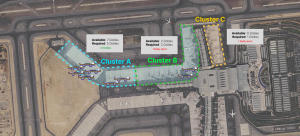
Cluster A has 7 dollies available against 5 required. A healthy surplus. Cluster B has 2 against 3 and already short by one. Cluster C has zero against 1 required. A hard stop.

This is not a fleet size problem. It is a visibility problem. For ground handlers managing hundreds or thousands of dollies, carts, towbars and other assets, non-motorized GSE tracking provides the missing visibility into where equipment actually is and whether it is available when operations need it. And it plays out on ramps at airports around the world, every single shift.

Non-motorized GSE tracking of airport baggage dollies

The Real Cost of Poor GSE Visibility at Airports

When a cluster runs short, someone has to fix it fast. That usually means a supervisor walking the ramp to find equipment that should already be nearby. Or a handler driving across the apron to pull dollies from a cluster that has a surplus, assuming they know which one that is. Or, in the worst case, nobody realises until the turnaround is already underway and there is nothing to load onto.

A shortage at Cluster C does not stay at Cluster C. It delays the flight. It creates pressure on the handling team. It forces reactive decisions at exactly the moment when everyone is already operating under the tightest possible time window.

Why Non-Motorized GSE Is the Hardest to Track

Motorized GSE gets attention. Tugs, tractors, and vehicles have engines, fuel logs, telematics systems, and maintenance records. Someone is usually keeping an eye on them. Non-motorized equipment is different. Dollies, carts, and towbars move constantly between clusters, gates, and shifts. Once it moves, keeping track of it depends entirely on someone remembering to update a record. On a working ramp, that is a lot to count on. Traditional methods do not hold up at the pace ground operations actually run. Manual logs go stale within minutes on a busy ramp.

So supervisors end up doing what supervisors have always done. They Drive Around. They walk. They ask around. They find the dolly, move it, and get back to the next problem. It works until it doesn’t, and when it doesn’t, the clock is already running.

Airport dolly tracking with Alps Alpine asset tracker

How Non-Motorized GSE Tracking Creates Cluster-Level Visibility

proveo and Alps Alpine Asset Tracking built a different approach to this problem. Alps Alpine’s asset trackers are attached to non-motorized GSE, such as dollies, carts, towbars, and integrated directly into the proveo platform. The result is near-real-time location data for every tracked asset, mapped against the clusters where demand is building.

This also changes how reallocation decisions get made. Instead of moving equipment reactively, after a shortage has already shown up, a supervisor can see the imbalance building and act on it before Cluster B goes short and Cluster C hits zero. The surplus in Cluster A becomes useful information rather than something that only gets noticed after the fact.

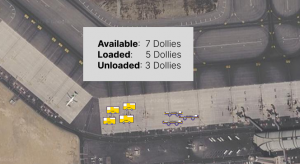
The loaded and unloaded status of each dolly adds another layer. A dolly sitting loaded in the wrong cluster is not available in the way an empty one is. Knowing the difference before sending someone to collect it saves time that a busy shift does not have.

Motorized and non-motorized GSE tracking in the proveo platform

How Non-Motorized GSE Tracking Creates Cluster-Level Visibility

One of the most practical aspects of this setup is that it does not require a separate system for non-motorized GSE. The Alps Alpine Asset Tracking trackers feed directly into the proveo platform alongside motorized GSE data. A fleet manager or supervisor gets one view of the full ramp without switching between systems or reconciling two separate data sets.

This matters in practice because cluster imbalances rarely involve just dollies. A shortage of non-motorized equipment often coincides with motorized GSE being tied up somewhere else. Seeing both in the same place makes it faster to understand what is actually happening and what needs to move.

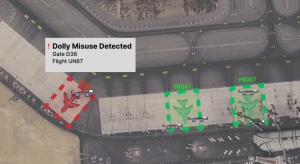
The misuse detection capability shows what is possible when you have this kind of visibility. When a dolly moves to a gate or cluster, it should not be in there, whether through honest mistake or informal reallocation; the platform flags it with the gate and flight number. A supervisor knows immediately, rather than discovering it when the next team goes to collect equipment that is no longer where it was left.

From Reactive Dolly Searches to Proactive GSE Management

The cluster scenario at the top of this post is not unusual. It is the default state of most airport ramps during a peak window. Equipment drifts. Clusters go out of balance. Someone finds out too late.

Getting ahead of it does not require a new fleet. It requires knowing where the fleet actually is.

With cluster-level visibility in place, the question stops being “where is it?” and becomes “where does it need to go next?” That shift from reactive to proactive is what changes the shape of a peak window. Reallocation happens before the shortage, not after. Supervisors manage the ramp instead of searching it. Flights leave on time.

For ground handling teams already running hard schedules with tight turnarounds, that is not a small operational improvement. It is the difference between a shift that runs and one that catches up all day.

Improve Visibility of Your Non-Motorized GSE

If your operation is managing dollies across multiple clusters and the balance across them is something your team finds out about after it becomes a problem, we are happy to talk through what near-real-time visibility could look like for your specific setup.

Reach out to the proveo team or get in touch with Alps Alpine Asset Tracking. We will start with the problem, not the product, and go from there.


Frequently Asked Questions About Non-Motorized GSE Tracking

What is non-motorized GSE tracking?

Non-motorized GSE tracking uses battery-powered tracking devices to provide location and status information for airport ground support equipment without its own power source, including dollies, carts, towbars and other mobile assets.

How can airports track baggage dollies?

Ground handlers can install tracking devices on baggage dollies to provide near-real-time location information. The tracking data can then be integrated into a GSE management platform to show the location and availability of equipment across airport operational areas.

Can motorized and non-motorized GSE be tracked in one system?

Yes. The proveo platform combines telematics data from motorized GSE with tracking data from non-motorized assets, giving ground handlers a unified view of their equipment.

What are the benefits of tracking non-motorized GSE?

Tracking helps ground handlers identify equipment shortages, locate misplaced assets, improve fleet utilization, reduce unnecessary ramp movements and make equipment reallocation decisions before shortages affect operations.

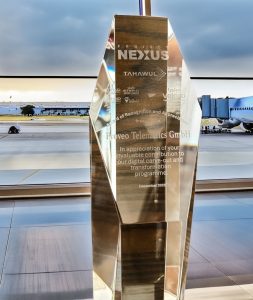
One highlight from this year that we want to share: Velora Aviation has recognized proveo with their Award of Recognition and Appreciation. proveo contributed to the Velora’s digital carve-out and transformation program. We are proud to be part of Velora’s transformation team.
We have been a partner of Velora Aviation, previously known as Etihad Airport Services, for over 15 years, supporting their airport ground handling and GSE maintenance through our advanced GSE platform. That kind of long-term relationship is something we do not take for granted.
The award reflects what a real partnership looks like. Velora’s team works hands-on with our product every day, and their input has directly shaped how our GSE fleet management platform and pooling solution has evolved over the years. Better airport ground handling processes, continuous improvements, all of it comes from this kind of close collaboration.
Thank you to the full Velora Aviation team. We are proud to keep building this together.
Velora Aviation GSE Airport Ground Handling Award Logo